
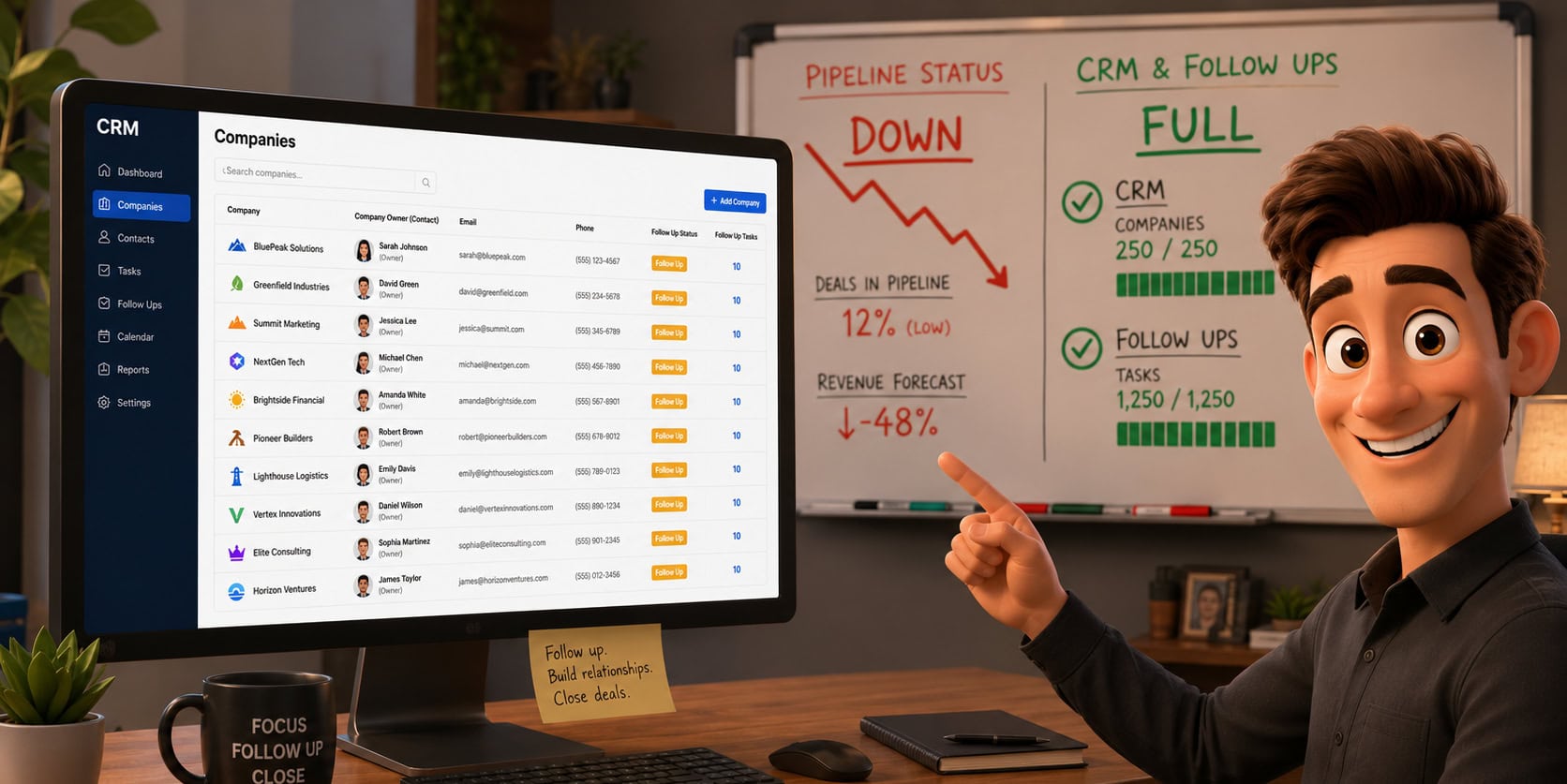
In a recent post, we spoke about the danger of only targeting the CEO when building a prospect list.
The point was not that CEOs are unimportant.
Of course they matter.
The point was that one senior name does not make a strong route into a business.
This article takes that idea a step further.
Because the problem is not only who appears on the hit list.
It is also how that list is built, worked, reviewed, and improved over time.
For many businesses, especially those relying on internal sales teams or outsourced sales support, there is constant pressure to keep adding new names to the prospect list.
On the surface, that feels like progress.
But a growing list does not always mean a stronger sales pipeline.
In fact, chasing new sales prospects every week can sometimes weaken your pipeline.
Not because new prospects are bad.
New prospects are necessary.
Every business needs a consistent flow of new opportunities.
But when the focus becomes “find more names” instead of “work the right opportunities properly”, the sales process can quickly become shallow.
That may create activity.
But it does not always create opportunity.
And this is where many sales teams get stuck.
They assume the answer to a weak pipeline is always a bigger list.
But sometimes the issue is not that the market has run out of prospects.
Sometimes the issue is that the right prospects have not been worked properly.
One of the biggest mistakes businesses make is treating hit list building as an admin exercise.
But a good hit list should do more than give your sales team names to call.
It should help the team make better sales decisions.
Those questions matter because every name added to a prospect list carries a cost.
So, the question should never only be:
“Can we find another company to add to the list?”
The better question is:
“Does this company belong on the list in the first place?”
That is where stronger B2B prospecting starts.
Not with more names, but with better reasoning.
When sales teams are under pressure to build pipeline, they often start spreading wider and wider.
There is nothing wrong with expanding a prospect base.
But there is a risk.
The team can end up going a mile wide and an inch deep.
They have touched many accounts but explored very few properly.
They have spoken to one person here, sent one email there, made one call somewhere else, and then moved on.
From a reporting point of view, there is activity.
But from a sales pipeline development point of view, the work may still be too thin.
Because many B2B opportunities do not open on the first attempt.
They often require testing different entry points.
That does not automatically mean the account is wrong.
It may simply mean the account has not been worked deeply enough.
This links back to the CEO example.
If a client says, “Target the CEO,” the salesperson may do exactly that.
The danger is that the account is then treated as if it has been properly worked.
But has it?
Probably not.
The CEO may be the final decision-maker, but the conversation may start somewhere else entirely.
It may start in operations, where the inefficiency is being felt.
It may start in HR, where the team is dealing with a people-related challenge.
It may start in sales, where revenue pressure is building.
It may start in procurement, where supplier performance is being reviewed.
It may start with a divisional manager who understands the problem long before it reaches the boardroom.
This is why strong outsourced sales teams do not only ask, “Who is the most senior person?”
They ask:
That is the difference between simply collecting names and building a proper sales prospecting strategy.
Another reason chasing new names every week can weaken pipeline is that teams often ignore the value of what they have already learned.
If your team contacted a business last week, that history matters.
That information should not disappear when the next hit list is built.
It should guide the next decision.
Sometimes the best use of research time is not finding a brand-new company.
Sometimes the best use of research time is reviewing what has already happened with a good-fit account and deciding how to approach it better.
That is where pipeline development becomes more disciplined.
Instead of saying:
“We need more names.”
The team starts asking:
“Which of the right names deserve a better second approach?”
That is a much more useful sales question.
When a business keeps feeding its sales team more and more prospects without enough qualification, the team can become spread too thin.
The result is a pipeline filled with activity, but not enough quality.
This is where outsourced sales support can add real value, especially for businesses that do not have enough internal time or structure to manage consistent prospecting properly.
The value of an outsourced sales team is not simply that they make calls.
The value lies in helping the business build a stronger sales pipeline through better targeting, better qualification, better follow-up, and more consistent market engagement.
That means identifying the right prospects.
But it also means knowing what to do with those prospects once they are identified.
That is where sales outsourcing becomes more than extra capacity.
It becomes a structured approach to pipeline growth.
A hit list should not get weaker as the months go by.
It should get stronger.
The more your team works a market, the more they should learn.
That learning should improve the quality of future targeting.
But that only happens if the list is treated as a working sales asset, not a once-off spreadsheet.
A good hit list should be reviewed.
It should be questioned.
It should be refined.
It should help the sales team build better judgement over time.
Because pipeline growth is not only about finding opportunities.
It is about learning where real opportunities are most likely to come from.
A full hit list can still be a weak hit list.
A large database can still produce poor sales results.
A long list of prospects can still create very little pipeline if the reasoning behind the list is unclear.
The goal is not to have the biggest possible list.
The goal is to have a list that helps the sales team focus on the right businesses, with the right approach, at the right time.
That means some prospects should be added.
Some should be worked again from a different angle.
Some should be nurtured.
Some should be disqualified.
Some should be removed completely.
That is not a failure of prospecting.
That is good sales discipline.
Before your sales team adds another hundred names to the list, it may be worth asking:
Have we properly worked the right prospects we already have?
Have we tested more than one point of entry?
Have we reviewed previous notes and conversations?
Have we followed up properly?
Have we explored the departments where the pain is most likely to sit?
Have we disqualified prospects for the right reasons, or simply moved on because the first attempt did not work?
These are the questions that turn hit list building from admin into strategy.
And for businesses looking to improve sales pipeline development, this is often where the real opportunity sits.
Not in chasing more and more names every week.
But in building a better prospecting process.
A more intentional one.
A more structured one.
A more disciplined one.
At MADjozi, this is a key part of how we think about outsourced sales.
Yes, we help businesses find and approach new prospects.
But more importantly, we help them build stronger prospect lists, qualify opportunities more carefully, and work the right accounts with greater consistency.
Because chasing new sales prospects every week can make a team feel busy.
But working the right prospects properly is what builds pipeline.


2025 © All rights reserved | Developed By Ever Digital
